
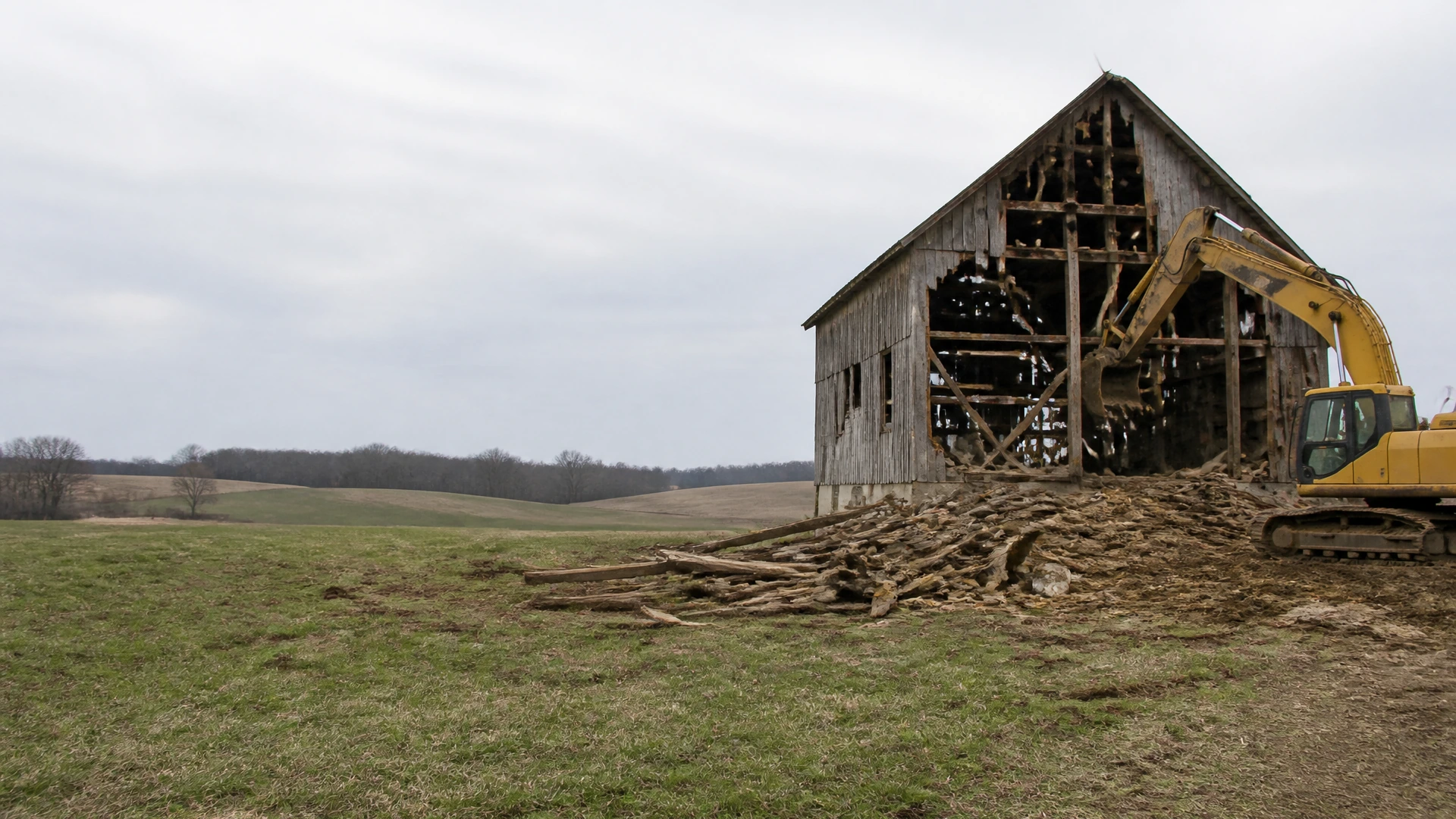
Barn Demolition in Northeast Ohio
If you're looking into barn demolition, you've probably watched that barn go downhill for years. The roof sags a little more every winter, a wall has started to lean, and at some point you stopped letting the kids or the animals near it, so barn demolition went from someday to soon.
- Owner-operated
- Owner on site for the work
- Free site visit and free written estimate
- Fully insured, $2 million general liability and workers comp
I'm Vental Waggoner, and I run Zenith Excavating out of Akron. We're a two-man operation, I'm on site and on the machine, and when a barn comes down, hauling the debris off, backfilling and finish grading the site are part of the price.
Tear down, take apart or restore
Before anything else, there are really three different jobs that get called barn removal, and it's worth knowing which one you're shopping for.
The first is straight demolition. A machine knocks the barn down, the debris gets loaded and hauled, and the site gets cleaned up. It's the fastest way by a long shot, usually a matter of days. That's the work I do, and I run the machine on it.
The second is deconstruction, which means taking the barn apart by hand, board by board and beam by beam, so the wood can be sold or reused. It can take weeks instead of days, and the labor runs two or three times what knocking it down would. The wood sales can cover some or all of that difference, but not always.
The third is restoration, which keeps the barn standing. If the frame is sound, that can make sense, and some barn restoration firms will tell you most barns can be saved. It's also the most expensive road, and it's not my line of work. If your barn is a good candidate for it, I'll say so.
So how do you know it should come down? The signs are pretty plain. Walls that lean, a roof that sags or has caved in somewhere, rot in the posts and sills, termite damage, a foundation that's crumbling, mold, and a barn that creaks and moves when the wind picks up. Once a barn is far enough gone that taking it apart by hand isn't safe anymore, demolition is the only option left.
What barn demolition costs
A barn isn't a shed. The price spread is wide, and it comes down to a few things you can see from the driveway.
Size is the first one. Most barn prices get figured by the square foot or by the job, so a big two-story bank barn and a small pole shed are nowhere near each other.
Then it's which of the three jobs above you want. Hand deconstruction for salvage costs a lot more than machine demolition, because it's slow, careful labor.
After that comes what's under and around the barn. A concrete floor, a block or stone foundation, a basement, or a silo next to it all add machine time, truckloads and dump fees. If asbestos or lead paint turns up, testing and abatement get added on top, and that alone can move the price a lot.
Then access. A barn at the end of a long farm lane, on soft ground, on a slope, or behind a line of trees takes more work to get to, and rural access in general adds time and trucking.
Every barn job starts with a free site visit and a free written estimate, because a phone call can't tell me how far the lane is or what's growing up around the back wall. Size, what's underneath and how far the trucks have to travel move what a house demolition costs the same way they move a barn price.
Salvage, free removal and what the wood is worth
You may have heard that somebody will take your barn down for free in trade for the wood. Sometimes that's true. It mostly works on old barns with hand-hewn timbers and hardwoods like oak or chestnut, the kind of wood timber framers and rustic furniture makers want. A barn built from regular dimensional lumber, or a steel building, rarely qualifies. Some salvagers keep a waiting list that can run for years, and it's worth asking two or three of them before you count on it.
Old barn wood does have value. Weathered boards, big beams, metal roofing, hinges and hardware can all be sold, as long as the wood isn't rotten. Check that before you plan around it.
Here's what people don't hear until it's too late. A free salvage job usually takes the good wood and leaves the rest. They often won't take the contents, the foundation or a silo. Some burn whatever they don't want right there on the site. You can end up with a pile of junk lumber, rubble, an old foundation and maybe a basement hole that's now a hazard, and then you're paying somebody to finish the job anyway.
When we take a barn down, the scrap goes on our trucks, the low spots get filled and the ground gets graded, and all three are in the price. Nothing gets left in piles.
How a barn comes down, step by step
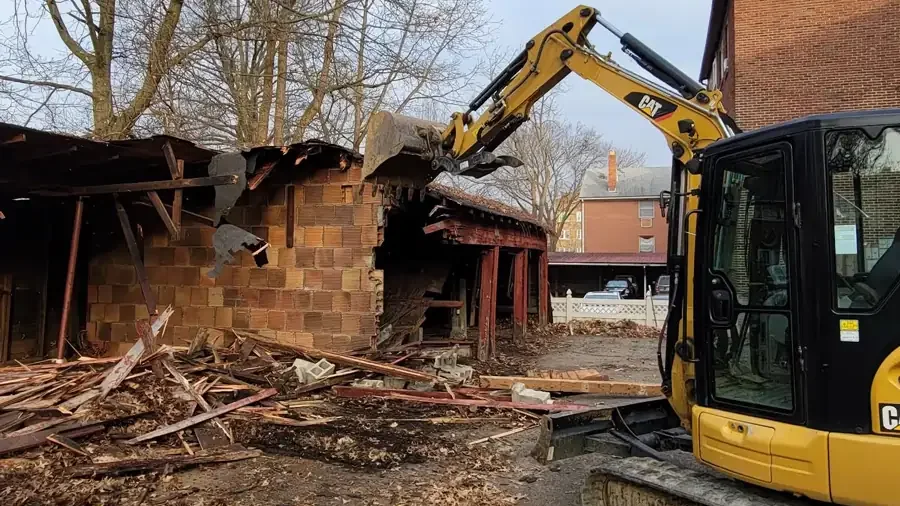
The order matters, and it's not something to improvise. It starts with the walk-through, then the utilities get confirmed off and any hazard testing gets done. If anything's being saved, like doors, windows or good beams, that gets pulled first. Then the barn comes down from the top: roof, rafters, wall boards, then the frame. You never undercut a wall and let a barn fall on its own schedule. After that, the debris gets sorted so metal and wood go where they should, and the rest gets loaded and hauled.
Barns usually come down with an excavator or a skid steer, depending on the size of the building and the ground around it. I'm on the machine.
Bank barns built into a hill
Some barns are bank barns, built into the side of a hill with a stone wall holding back the earth on the uphill side and a ramp of dirt leading up to the top floor. Taking one of those down raises a question nobody else answers: what happens to the stone wall and the earth ramp once the barn is gone?
That wall has been holding back a hillside for a long time. Pull it out and the slope behind it has to go somewhere, which is why the regrade matters as much as the teardown. That plan gets made at the site visit, before the barn comes down.
Silos and corn cribs
Silos are where a lot of barn deals fall apart. Plenty of salvage and free removal offers leave the silo standing, and some people end up hiring a second crew just to bring one down. A silo also adds real complexity to a barn job, because it's tall, heavy and has to fall in a direction you choose.
Corn cribs are smaller, but they usually sit close to the barn and need to come out in the same job.
Asbestos and lead paint
Older barns can have asbestos in the roofing or siding, and lead in the paint. If either is suspected, it gets tested before demolition starts. An inspection of a barn is a separate cost, and if something turns up, abatement adds to the job.
Zenith does not do asbestos or lead abatement. That work is done by a licensed abatement contractor, and we coordinate with them so the barn comes down after their part is finished. Whether the state needs a survey or a notice before a barn is demolished is a question to check with the county or Ohio EPA.
Permits and utility shut-offs
Some places require a demolition permit for a barn and some may want an environmental inspection, and a few barns are protected by historic rules. Whether an agricultural exemption applies to your barn depends on where it is, so check with the county and your township before you plan around a date.
The power has to be off before anything comes down. On older farms, it's not always obvious whether a barn still has a live line running to it, and nobody wants to find out halfway through. Water and gas get shut off too, and buried lines get marked through 811 before any digging.
Old fuel tanks, cisterns and wells
Farms have things in the ground that a house lot doesn't. An old fuel tank for the tractors. A cistern under the floor. A hand-dug well beside the barn that got covered with boards a long time ago and forgotten. If the machine finds one, the work on that spot stops. A covered well or cistern is a fall hazard, and an old fuel tank has its own rules about who has to be told. Check with the county on well sealing and fuel tanks.
Working around livestock, pasture and farm lanes
A barn job isn't in a back yard. It's in the middle of a working property, and that brings questions a house demolition never does.
Farm lanes and gravel driveways take a beating from heavy equipment and loaded trucks. It's not unusual for a lane to need a load of base gravel after a big job.
Then there are the animals. Can the cattle, horses or chickens stay in the next pasture while the barn comes down? Can the hay and the equipment stay in the shed next door? Plan on moving animals, hay and equipment well clear of the work, and the details get settled at the site visit.
And the ground. Machines on a pasture or hayfield can leave ruts. Finish grading is part of the price, so the site gets shaped back, but people want to know when they can plant or graze there again. That depends on the season and the weather, so ask when I'm out there.
Where the debris goes
A barn turns into a lot of material: wood, metal roofing, shingles, concrete and stone. The metal and clean wood get sorted out, and the rest gets loaded and hauled. Asphalt shingles often need their own disposal arrangement, so ask about them.
Debris haul-off is included in our price. Some people burn the rotten wood on site or bury rubble in a hole on the property. Whether either is allowed where you are is a question for the county and Ohio EPA, so check before anybody does it.
Foundation, floor and the site after
When the barn is down, what's left is the foundation, the floor and sometimes a partial basement. A concrete floor or foundation adds machine time and dump fees, and an old stone base takes longer still. A basement that gets left open after a barn comes down is a hole somebody can fall into.
Backfill is included in our price. For a big slab on its own, see concrete removal.
The site gets backfilled, graded and left level for whatever's next. Then there are the nails. A barn is full of them, and they end up everywhere, in the grass, the gravel and somebody's tire.
What people do with the land after is up to them. A new barn or garage, more pasture, an orchard, a garden, a guest house.
How long it takes
A straight machine demolition of a barn is usually a matter of days on site. Hand deconstruction for salvage can take weeks. Doing it yourself with a small crew takes longer than either.
What to get in writing
Whoever takes your barn down, get the details in writing. That means when the job ends, when payment is due, which materials the contractor takes and which stay yours, and what the site looks like when they leave. A pile of rubble left behind is not the same as a graded site.
Our written estimate is free.
Who does the work
Ask anybody for proof of insurance before they bring a machine onto your property. You want liability coverage for damage and coverage for workers who get hurt, so it doesn't land on your own policy. We carry $2 million in general liability plus workers compensation.
Get more than one quote, ask whether disposal is included, and ask about real barn experience. And make sure the company is a real business you can find. A lot of people looking for barn help find that many of the contractors they call never call back.
Zenith Excavating is me and one other guy. I started the company in 2022, and we're at 3397 E Waterloo Rd in Akron. We take barns down across Stark, Wayne, Tuscarawas, Portage, Summit, Mahoning and Columbiana counties, from around Wooster and New Philadelphia up to Kent and over to Youngstown. I'll tell you what, a lot of farm country out here gets passed over by the bigger demo outfits. See everything else we do on the Zenith Excavating home page.
Questions People Ask
Can I tear the barn down myself?
A small, simple barn, maybe, if you've got the equipment, the safety gear and a plan for the debris. Big barns and leaning ones are a different story, and people do get hurt doing it. Some folks pull the salvage themselves and leave the rest to us. I'll tell you straight which kind of barn you've got.
Will taking the barn down lower my taxes or insurance?
It might. Fewer buildings can mean less liability and a lower insurance bill, and a removed building can change your property value. That's a question for your county auditor and your insurance agent, not for me, so ask them before you count on it.
Do I need to tell the county auditor the barn is gone?
Check with your county auditor's office on how they want to hear about a removed building. Each county handles it its own way.
What about bats, raccoons or barn owls living inside?
Fair question. If you think a protected species is in there, check with the county or the state wildlife office about timing before you schedule anything.
Can somebody really take my barn for free?
Sometimes, if the wood is the old hand-hewn kind. Just know a free job usually leaves the foundation, the silo and the junk wood behind, and that's covered above.
Do you work in my county?
We cover Summit, Stark, Portage, Wayne, Tuscarawas, Mahoning and Columbiana counties, including the rural parts. The site visit is free.
If that barn's had its day, Request a Free Estimate and I'll come walk it with you. Fill out the form and hit Send My Request.