
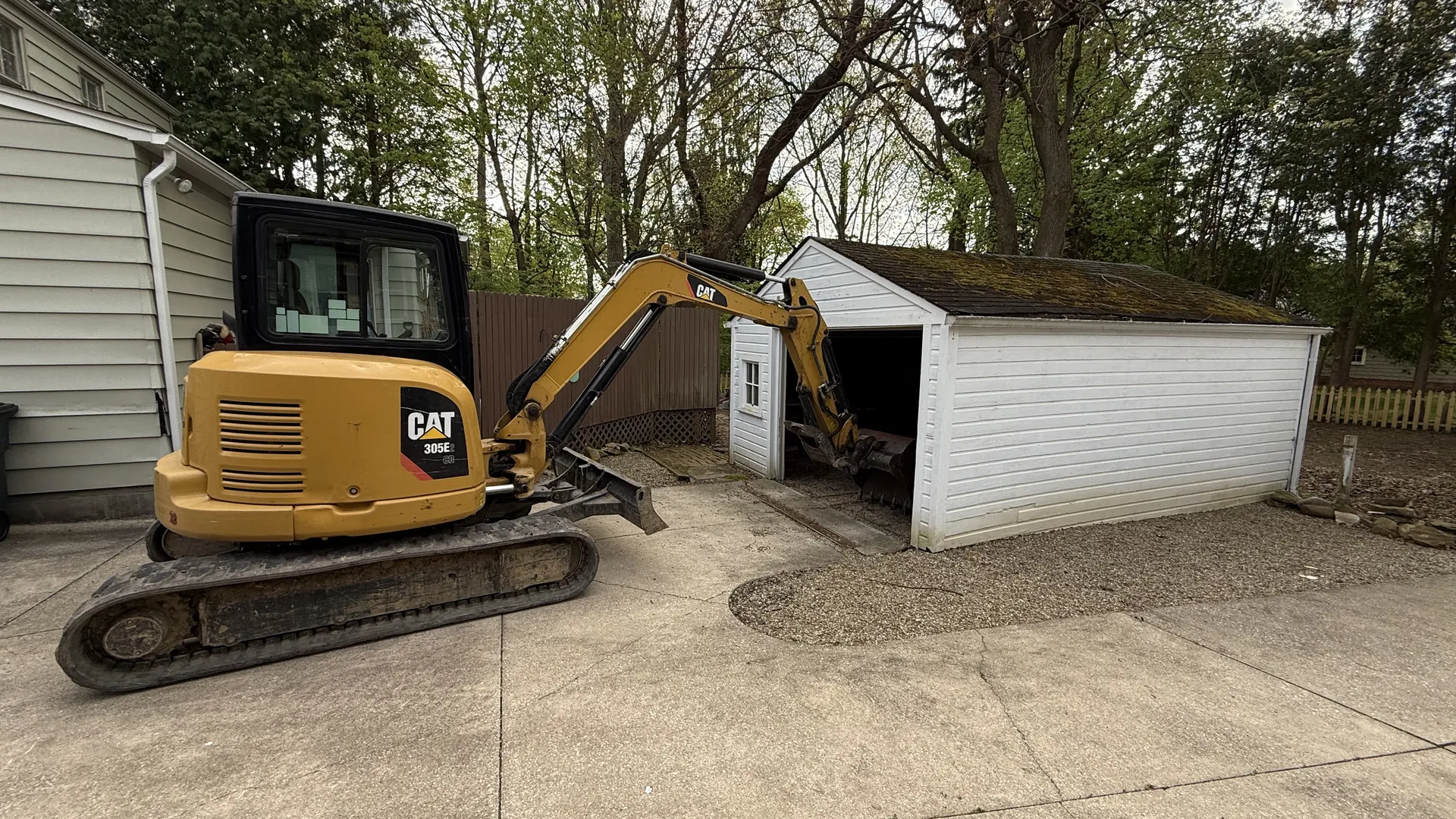
Garage Demolition in Akron and Canton
Your garage is leaning, the roof is sagging, or the door hasn't opened since the last owner, and now you're looking up garage demolition in Akron. Maybe the insurance company finally said something, maybe you want the space back for a new garage, or maybe you're just tired of looking at it.
- Owner-operated
- Owner on site for the work
- Free site visit and free written estimate
- Fully insured, $2 million general liability and workers comp
A garage teardown is exactly the kind of job the big demo companies around here pass on because it's too small for them. It isn't too small for us. Zenith Excavating is me, Vental Waggoner, plus one other guy, and when your garage comes down I'm the one in the seat of the machine. This page is about how the work actually goes.
Garages we tear down
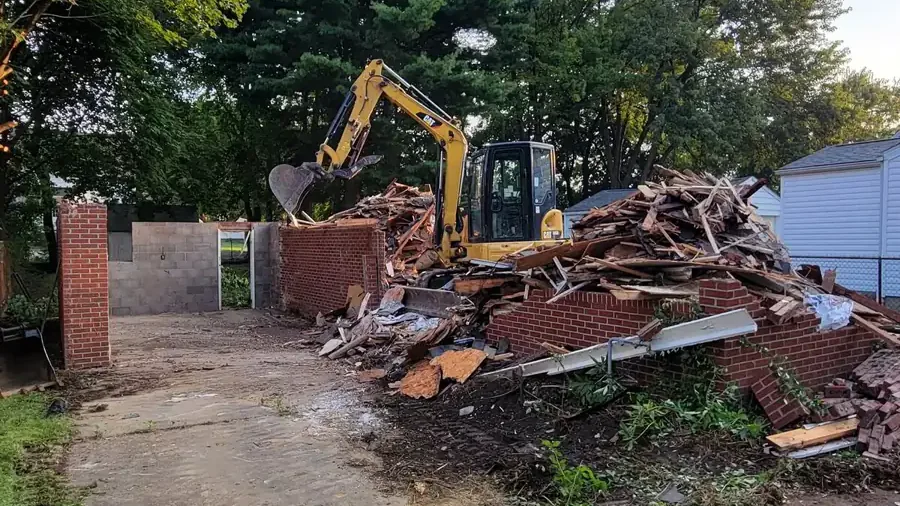
Around Akron and Canton, most garages are detached one and two car buildings: wood frame, concrete block, sometimes brick, often with a slab that's cracked into pieces. We also take attached garages off houses, which is a different job with more steps, and that has its own section below.
How a garage teardown runs
It starts with a free site visit. I look at the garage, what it's built from, how close it sits to the house, the fence and the neighbor's yard, and how a machine and a truck can get back to it. Then you get a written estimate.
On the day of the job, the garage comes down with a machine sized to the space. A wood garage on a tight city lot doesn't need the same machine as a block garage on a country lot, and bringing a bigger machine than the job needs just tears up more yard. Block and brick walls get broken down. Then the debris gets loaded and hauled, the spot gets backfilled where needed and finish graded.
Market sources put a detached garage at about a day to tear down plus about a day to haul, and an attached garage at three days or more, because of the care it takes around the house. Permit approval can add time before any of that starts.
Permits and utility shut-offs
Plenty of places want a permit before a garage comes down, even a detached one, and some combine it with a house permit when both are going. Ask early who is pulling it, you or the contractor, because a permit can take a week or two to come back. Check with your city or township on whether your garage needs one.
Then there are the utilities. A lot of garages have electric, and some have gas for a heater or water for a utility sink. Those have to be shut off and disconnected before anything comes down, which usually means the utility and an electrician or plumber.
The one people forget is the power line that runs out to the garage. It might be overhead from the house or buried in the yard, and it doesn't stop being live just because the garage is going away. It has to be cut and made safe back at the house, and whether that needs an electrician's permit is a question for your city or township.
Attached garages
An attached garage shares a wall, and usually a roofline, with the house you're keeping. That changes everything about the job. The garage has to come off without damaging the house, sometimes with temporary support while it happens. Any wiring, plumbing or gas running through the shared wall has to be rerouted or capped. And when the garage is gone, the house has a wall that was never meant to face the weather.
That exposed wall needs to be sealed and sided, and the roofline may need to be fixed where the garage tied in. That's carpentry and siding work, not demolition, so plan for it before the garage comes down.
Asbestos and lead paint
On a garage built before the 1980s, asbestos usually turns up in the old shingle siding or the roofing, and sometimes in the joint compound if somebody drywalled the inside. We don't handle asbestos at Zenith. That job belongs to a licensed abatement contractor, and once they've cleared the garage, I put our teardown on the calendar behind them. Ask your city or township and the county whether an outbuilding like yours needs a survey first.
Lead paint is the other one. A garage painted before 1978 likely has lead under the newer coats, and there's a lot of painted block on older garages around Akron. Painted debris may need to go to a landfill that takes it, and that's something to check with the county.
Keeping the slab
Here's a question that saves people money and almost nobody asks: can you keep the slab? If the garage floor is in decent shape, it can stay and become a patio, a parking pad or the base for a shed. If it's cracked, heaved or sitting at the wrong height, it should come out with the garage.
I'll tell you honestly at the site visit which one yours is. A slab that's breaking up will only get worse, and paving over it later costs more than taking it out now.
Protecting the house, the yard and the neighbors
A lot of garages sit at the back of the lot, which means the trucks have to get back there. The question people ask is whether the trucks will crack the driveway on the way. A loaded truck is heavy, and an old, thin driveway can crack under it, so the access route gets planned at the site visit.
The other worry is what's right next to the garage: the fence, a tree, the neighbor's yard a few feet away. Garages are often built tight to the lot line, and that's where a careful machine operator matters. With an attached garage, the house itself is the thing being protected.
While the job is going, plan on the area around the garage and the driveway being off limits, for your safety and the neighbors'.
Partial teardowns and interior strip-outs
Not every garage needs to come all the way down. Sometimes the frame is solid and only the siding, the roof or a rotted wall needs to go. Sometimes people want the inside gutted, the old shelving, drywall and insulation pulled, so they can redo it as a shop. Keeping the frame costs less than a full teardown, and an interior strip-out is a smaller job again. For inside work in a house, see interior demolition.
Salvage and recycling
Before the garage comes down, pull what you want. A garage door in good shape can be sold, and so can a metal roof, good lumber or old hardware. Concrete and metal are the most recyclable parts of a garage, and the rest mostly goes to a landfill.
After the garage comes down
When we leave, the spot where the garage stood is backfilled where needed and finish graded. That's part of the price. People want to know what they'll actually be looking at: bare dirt, gravel or grass. If you're putting a new garage there, a clean graded spot is what your builder wants. If you want lawn, the ground has to be seeded.
Tear down, repair or rebuild
If the garage is just ugly or outdated, it might be worth fixing. If the frame is rotted, the slab has heaved and the roof is going, it's a teardown. A garage that's too small for today's cars is another reason people take one down to build bigger. Code changes can also force repairs, so ask your builder what a repair would actually take.
I'll say plainly when a garage is worth saving. We don't build garages, so a rebuild goes to a builder after we've cleared and graded the spot.
Who does the work and where
Two of us do the work, and I'm the one running the machine. Every garage job is backed by a $2 million general liability policy, with workers compensation on top of it. The shop is at 3397 E Waterloo Rd in Akron, and we take garage jobs in all seven of our counties: Summit and Stark, then Portage, Wayne, Tuscarawas, Mahoning and Columbiana. The detached garages squeezed onto narrow city lots in Akron, Cuyahoga Falls, Canton and Massillon are where the machine work gets tightest.
Questions People Ask
Can I tear down my own garage?
A small detached wood garage is the one case where some people do it themselves, renting a machine and a dumpster. An attached garage is not a DIY job, because the house is on the line. When you hire it out, the risk moves off your shoulders and onto the contractor's insurance, so ask what they carry. Ours is the $2 million liability policy and workers compensation mentioned above.
Do I have to empty the garage first, and will you haul the junk inside?
Empty it of anything you want to keep, for sure. What happens to the rest, the old paint cans, the tires, the broken lawn mower, is worth settling at the site visit so it's in the written estimate.
Does tearing down the garage lower my property tax?
It can, because the garage is part of the assessed value of the property. The county auditor has to take it off the record, and how that happens varies. Check with the county auditor's office after the job.
Is a concrete block garage harder to take down?
Yes. Block has to be broken, not just pulled, and the debris is heavier to haul. If the block is painted, the paint may change where it can go.
Will you build the new garage or pour the new slab?
No, we don't build. We clear and grade the spot so it's ready for whoever does.
Got a garage that's done? Fill out the form, tell me where it is, and I'll come out and look at it for free, then put the number in writing for you. If you'd rather talk, the number is (330) 690-6842, and our hours are Monday through Friday, 7 to 5. Head back to the Zenith homepage for everything else we take down.