
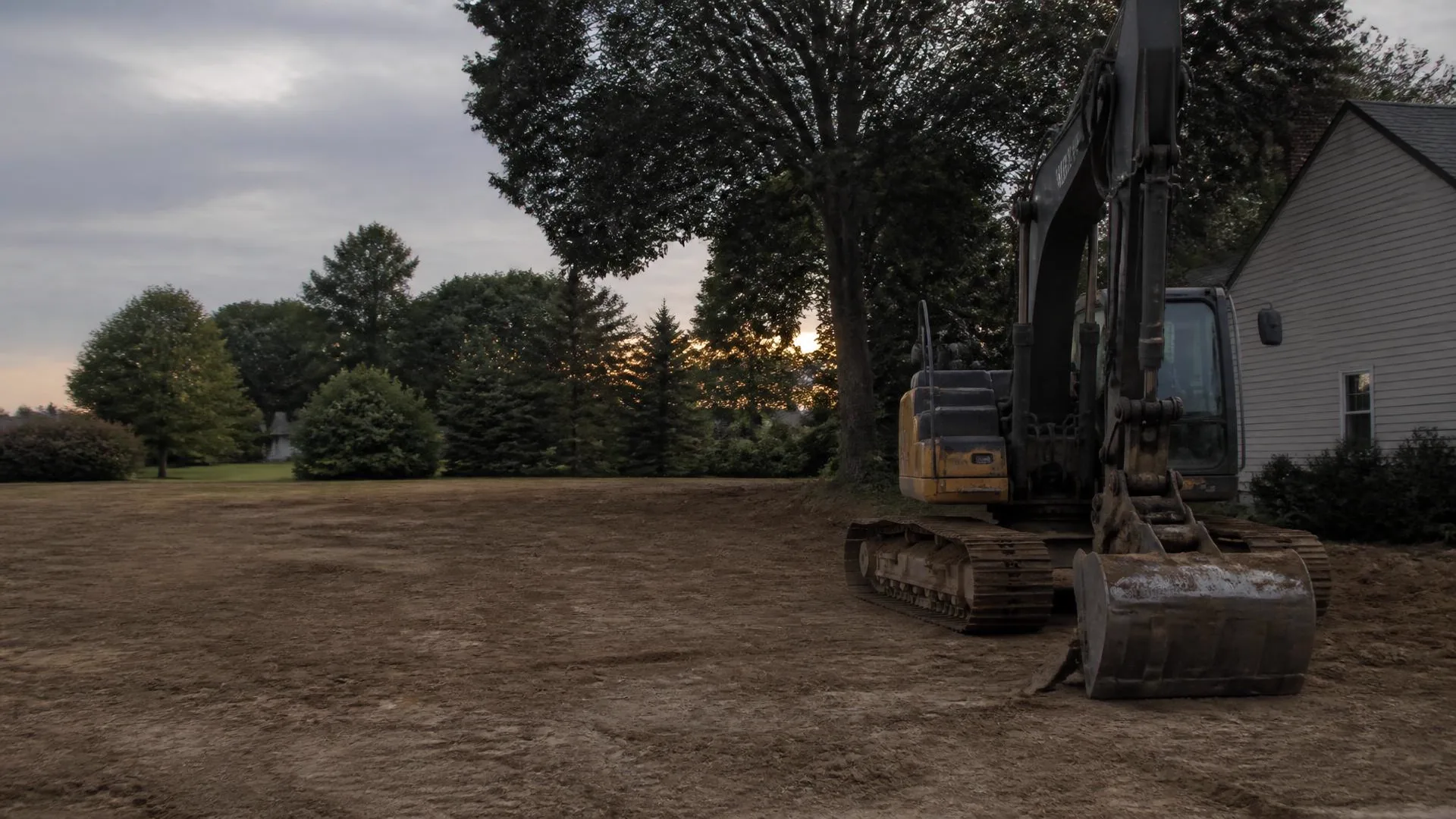
Mobile Home Removal and Demolition in Northeast Ohio
Maybe it's the old single-wide on the back of the family property that nobody's lived in for years. Maybe you bought land with a trailer on it you never wanted, or the roof finally gave up and the floors went soft. Whatever the story is, you need mobile home removal, and you're probably finding out that most of what's online about it was written for somebody in another state.
- Owner-operated
- Owner on site for the work
- Free site visit and free written estimate
- Fully insured, $2 million general liability and workers comp
I'm Vental Waggoner. I started Zenith Excavating in 2022, and we're a two-man demolition operation based at 3397 E Waterloo Rd in Akron. When we take down a mobile home, I'm on site and on the machine for the whole thing. We cover seven counties, from Summit, Stark and Portage down through Wayne, Tuscarawas, Mahoning and Columbiana, and a lot of mobile home calls come from out in the country around Wooster and New Philadelphia, on back roads where the nearest neighbor is a field away. Taking the debris away, filling the low spots and grading the lot smooth all come in one number.
What mobile home removal costs
Every mobile home job gets priced on its own, and I'd rather explain what moves the number than throw out a figure that doesn't fit your trailer.
Size comes first. A single-wide is one box. A double-wide was built as two halves, and it has to be split back apart to come down and haul out, so it's more work. Homes with three or more sections add more on top of that.
The roof matters more than people expect. A home with a shingle roof costs more to tear down and dispose of, because the shingles add a lot of heavy debris to haul.
What's left inside makes a big difference too. A home that's been emptied out costs a lot less to take down than one still full of furniture, appliances and thirty years of stuff. If you can clear it out yourself, do it.
Then there's access. A home on an open, flat lot by the road is the easy version. A home back in the woods, on a slope, down a long dirt lane or packed into a tight spot is slower, and the machine time adds up.
Disposal is a real piece of the cost. Demolition debris gets hauled to a landfill that takes construction and demolition waste, and the landfill charges by weight or volume. Mixed loads that haven't been sorted cost more to dump. With us, the haul-off is part of the price, so you're not paying a separate dump bill.
Location plays in as well. Rural jobs tend to run cheaper than city jobs, and how far the site is from the landfill matters. Permits are their own line, and they're covered further down.
The free site visit and free written estimate cover every one of those things, and you'll see what's included in writing before anything starts. Compared with tearing down a regular stick-built house, a mobile home is usually the cheaper of the two, since there's less material to break up and haul.
How mobile home removal works
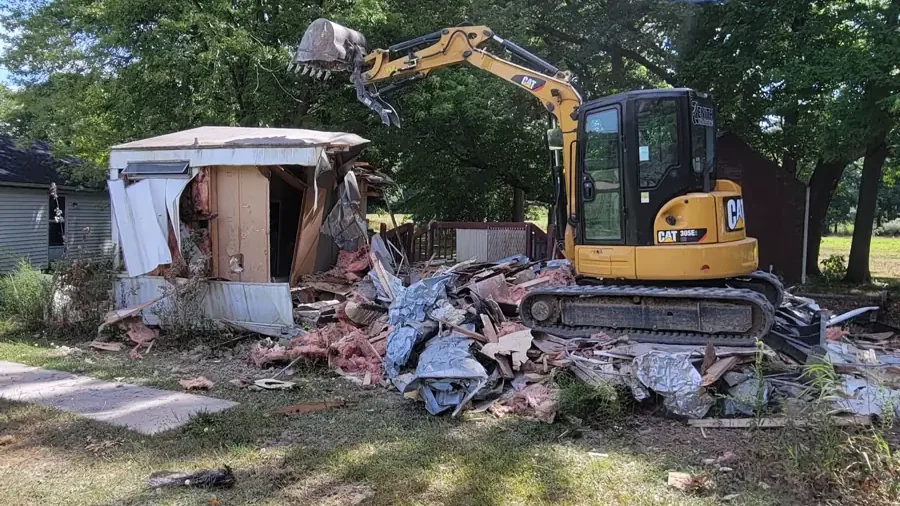
It starts with the site visit. I come out, walk around the home and the lot, look at the roof, the access, what's attached to it and what's underneath it, and then you get a free written estimate. Get a couple of quotes from other people too, that's smart on any job this size, and when you compare them, check line by line what's included. Some quotes leave out the dump fees, the permit or the cleanup, and then the cheap one isn't cheap anymore.
On insurance, Zenith's coverage is $2 million in general liability, along with workers compensation. Every contractor you're comparing should be able to put proof of theirs in front of you, so ask.
Before the job, get anything you want to keep out of the home, the keepsakes, the photos, the tools in the shed. Take some pictures of the site so you've got a record of how things looked. And let the neighbors know when it's happening, because a machine tearing down a home makes noise and it's nice not to surprise anybody. Make sure the cleanup is spelled out in whatever you sign.
On the day, we take the home down, load the debris and haul it off.
Asbestos, propane and utilities
Mobile homes built before the 1980s often have asbestos in them. Asbestos has to be tested for and, if it's there, removed by people certified to do it. We don't touch it ourselves. A licensed abatement contractor takes it out, I work our schedule around theirs, and the machine stays parked until they're finished. There may also be a required notice to the state before a demolition, so check with the Ohio EPA or your county before the work is scheduled.
Propane tanks have to be disconnected and purged by the propane company before we start, and any refrigerant in an old air conditioner or heat pump has to be recovered properly. If there's anything else on the property that could be dangerous, chemicals, gas cans, old ammunition, tell me about it at the site visit. All of it has to be out before the machine starts.
Every utility has to be shut off and the lines capped before the home comes down. That means calling the water, gas, electric and sewer providers. Don't try to disconnect gas or electric yourself.
There's one piece that gets missed a lot. A lot of mobile homes are fed from an electric meter on a pole or a pedestal in the yard, with an underground line running to the home. Once the home is gone, that pole and that line are still there. Call the power company about the meter, and plan for who deals with the pole and the buried wire.
Permits, title and paperwork
You'll almost certainly need a demolition permit, and there may be a waiting period between applying and starting. The rules aren't the same in every city and township around here, so check with your city or township, or the county building department, before you set a date. Permit costs are often left out of quotes, so ask.
Mobile homes are also titled, kind of like a vehicle, and that trips people up. You'll need proof you own it to get a permit, and if you're planning to sell or donate it, the title has to be clean, meaning no missing title and no liens. If the title is lost or there's a loan still on it, get that sorted out first. Check with the county about the title steps for a manufactured home.
After it's demolished, don't forget to cancel the title and get the home taken off the tax list so you're not getting a bill for a home that isn't there anymore. Check with your county auditor on how that's done. Some places want proof that the home was destroyed.
Porches, decks, sheds and carports
Almost no mobile home is just the home. There's usually a wooden porch or stairs, a deck off the back, a carport, a shed, maybe a slab of concrete. All of that has to go too, or at least be decided on, and it adds to the bill. It usually makes sense to have it all done in one visit while the machine is already there. If you're only dealing with a shed, a deck or some concrete, we've got pages on each of those.
Salvage and scrap metal
There's some value in an old mobile home if you know where to look. The steel frame, the axles, aluminum or steel siding, copper wiring and appliances can all be scrapped or sold. Some people take the slower route and strip it piece by piece, selling what they can, which can knock some money off the cost but takes days instead of hours.
Piers, cleanup and finish grading
When the home comes off, what's left is the stuff it was sitting on. Mobile homes usually sit on piers or concrete blocks, held down with metal tie-down straps anchored into the ground, and sometimes on a concrete pad or a block foundation. All of that has to be cleared before the lot is usable again.
A lot of companies treat grading as a separate job from cleanup. We don't. Once the home and the junk are hauled off, we fill in the low spots and smooth the ground so the lot drains and looks like a lot again, and that backfill and finish grading is already in the number you were quoted.
The septic tank and well
This is the part almost nobody talks about. If the home was out in the country, it probably had its own septic tank and maybe its own well. Once the home is gone, those are still in the ground. An old tank that isn't closed off the right way can turn into a hazard down the road. There are usually rules for how a septic tank gets properly abandoned, and they're set at the county level, so check with your county health district before anything gets crushed or filled. A well that's no longer being used should be dealt with the right way too, and the health district can tell you what that means.
Demolish, sell, donate or move it
Before you pay anybody to tear it down, it's worth asking whether you have to. To be truthfully honest, demolition isn't always the right call, and I'll tell you if I think it isn't.
If the home is in decent shape, selling it as-is usually gets you the most money, but it can take weeks or months, and the buyer has to move it. Some charities take newer mobile homes for affordable housing, and there can be a tax deduction in it, though the home has to meet their standards and the paperwork takes a while. Some fire departments take a home for a training burn, but the asbestos has to be out first and they have their own process.
Moving it to another site is another option, but it isn't cheap. There are permits, transport, and all the porches, stairs and skirting have to come off first. Some older homes are too old to be moved or set in a new park.
Removal makes sense when the repairs cost more than the home is worth. Soft or sagging floors, a roof that's been leaking for years, mold, termites, a frame that's rusted through, and sometimes a code enforcement order from the city. When it gets to that point, demolition is usually the cleanest way out.
Questions People Ask
How long does it take to demolish a mobile home?
A single-wide can come down and get loaded out in a matter of hours once the permit and the utilities are handled. A double-wide or a home with a lot of add-ons takes longer.
Can you remove a home from a mobile home park?
Parks have their own rules, and some of them are strict. A park may charge an exit fee, require you to use certain contractors, or limit the hours work can happen. Check with the park office first.
Can I just tear it down myself?
You can do some of it, like pulling the skirting or taking down a small porch. The full teardown is another story. It takes machines, permits and a way to haul and dump a lot of heavy debris, and it's no place to learn about asbestos the hard way. By the time you add it all up, hiring it out is usually cheaper than people expect.
Is there an Ohio program that helps pay to replace or recycle an old mobile home?
Some states have run programs like that. Check with the state housing agency or the Ohio EPA to see if anything is running here.
What if you find a buried oil or fuel tank?
It happens on old rural properties. If a tank turns up, the work around it stops until we know what's in it and how it has to be handled.
Will the machine tear up my driveway or yard getting to the home?
I look at the way in during the site visit, so we plan the route before the machine ever rolls. Any ruts left in the yard get backfilled and finish graded as part of the job.
How soon can I set a new home or build on the lot?
That depends mostly on your permits and whatever's going in next. When we leave, the debris is gone and the ground is backfilled and finish graded.
What happens if it rains during the job?
A light rain usually doesn't stop a teardown. A soaked lot is different, because a machine and loaded trucks can rut wet ground pretty bad, so a hard rain can push the work back until things firm up. How your lot drains is one of the things I look at during the site visit.
Request a Free Estimate
Got a mobile home that needs to go? Use the form to tell me the road it's on, single or double, and what shape it's in, then press Send My Request and I'll be in touch about walking the lot for free. Phone works too: (330) 690-6842.
Back to Zenith Excavating home.