
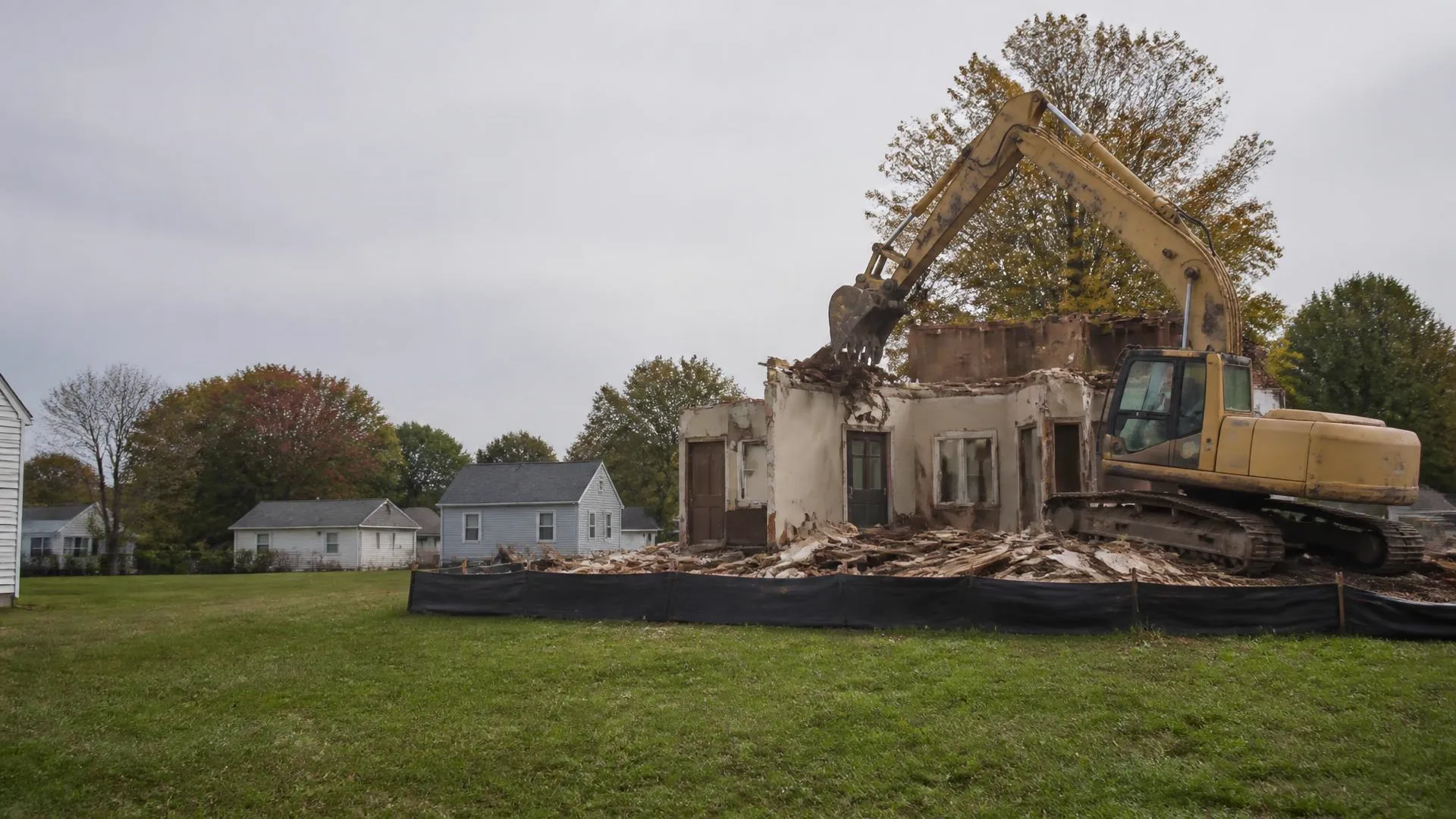
House Demolition in Akron and Canton
You've got a house that needs to come down, and you're trying to figure out house demolition in Akron without getting buried in it. Maybe you inherited a place nobody can live in, maybe you bought the lot for what it could be and not for what's standing on it, or maybe the city has started sending letters.
- Owner-operated
- Owner on site for the work
- Free site visit and free written estimate
- Fully insured, $2 million general liability and workers comp
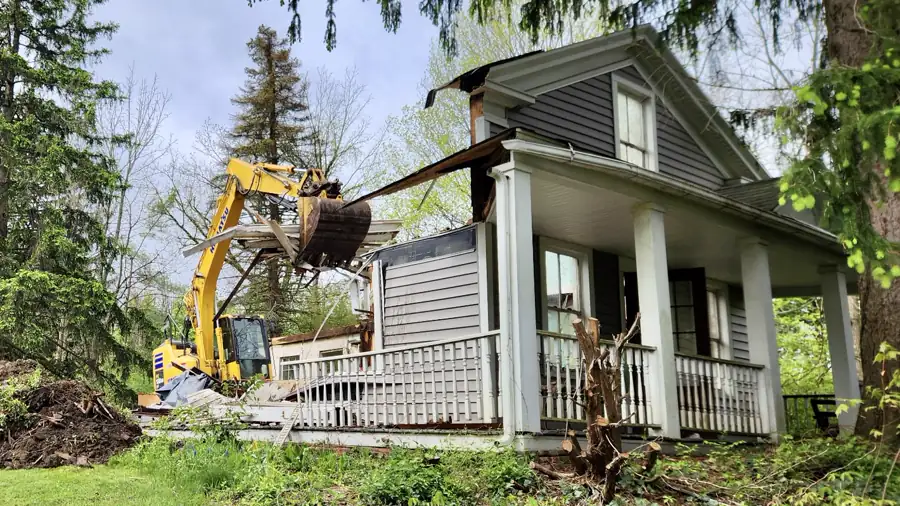
Whatever got you here, a house teardown is a bigger job than it looks from the street. There's the basement, the gas line, the well out back, the neighbor ten feet away, and the question of what the lot looks like when everybody leaves. Whoever walks your lot at the site visit is the same person sitting in the machine on teardown day, and that's me, Vental Waggoner, owner of Zenith Excavating. Here's how the whole thing works, start to finish.
Salvage, scrap and deconstruction
Before anything comes down, settle one question that almost nobody asks: who owns the scrap and the fixtures in that house? The copper, the cast iron tub, the old oak doors, the cabinets, the light fixtures. Until the contract says otherwise, that stuff is yours, and some of it has resale value or could go to a reuse store.
There are two ways to take a house down. Regular demolition is machine work: the house comes down, the debris gets loaded and hauled. Deconstruction is the slow version, where the house gets taken apart by hand so the lumber, fixtures and trim can be reused. Deconstruction takes more labor and more days, so it costs more, and the resale or donation value of what comes out can offset some of that. For most houses around Akron, the honest answer is that the salvage isn't worth the extra labor, but there are exceptions, and an old farmhouse with good timber is one of them.
The simple middle path is to pull what you want before the teardown. Take the fixtures, the doors, the mantel, whatever matters to you, and then the machine takes the rest.
Tear down or remodel
I'll give you my honest take on this, even if it costs me a job. A house with a bad foundation, rot in the framing and a roof that's been leaking for years is usually a teardown, because by the time you fix all three you've paid for a new house and still own an old one. A house with good bones and a dated kitchen is a remodel, not a demolition, and I'll tell you that at the site visit.
The gray area is everything in between, and that's where it helps to have someone walk it with you who doesn't make money on the remodel.
Fire-damaged and condemned houses
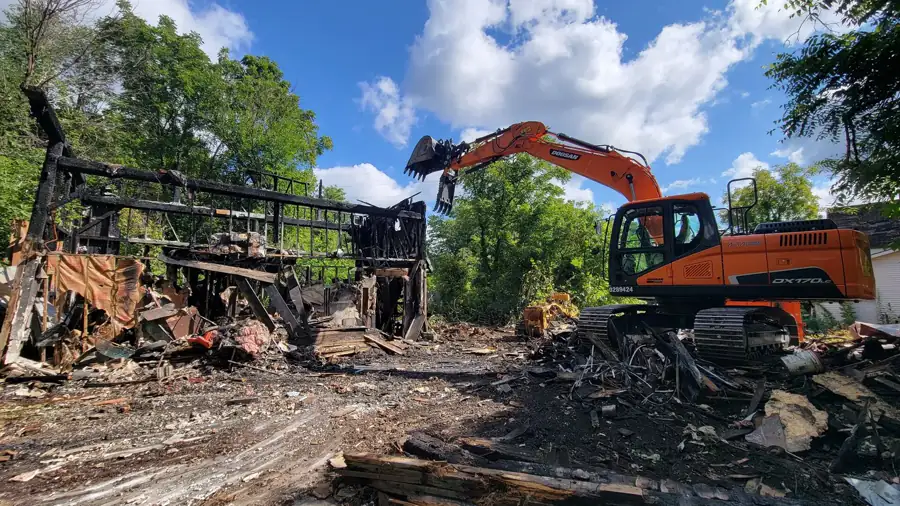
A house after a fire is a hard thing to stand in front of, and the last thing you need is a contractor who makes it more complicated. Fire-damaged houses usually come down whole, because smoke and water get into everything, and the debris has to go to the right place.
If the fire was covered, check your home insurance policy for debris removal coverage. A covered fire claim often pays for debris removal, but every policy is different, so read yours or call your adjuster before you sign anything. I can give you a written estimate to hand to the adjuster, since the site visit and the estimate are free either way.
Condemned houses are a different kind of pressure. When the city or township has ordered a house down, there's usually a deadline attached. Check with your city or township on what the order says and what they need from you, and bring that paperwork to the site visit.
How a house teardown runs
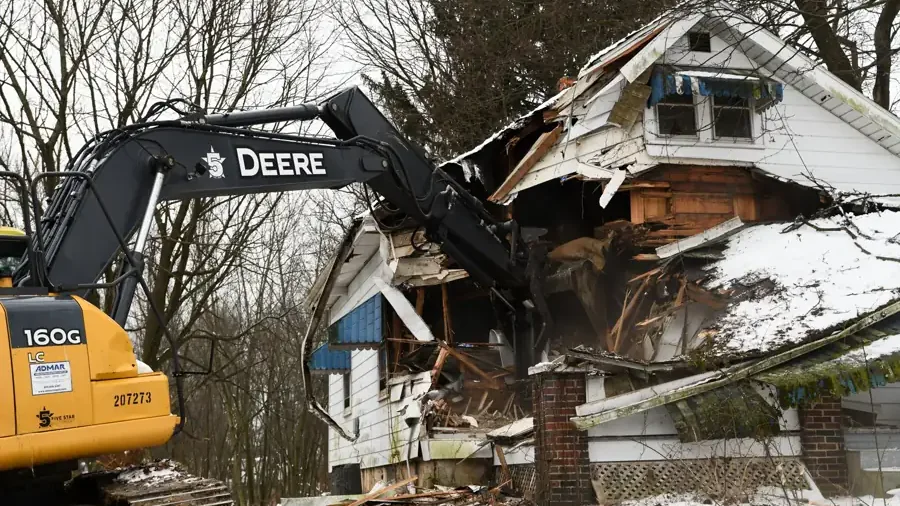
It starts with a free site visit. I walk the house, the yard, the access and the houses next door, and then you get a written estimate. If the asbestos survey finds something, abatement happens before anything else. After that, the permit gets pulled and every utility gets shut off and capped.
On teardown day we bring the house down, sort and load the debris, and haul it away. Then the basement or crawlspace gets broken down and filled, and we finish grade the lot. Haul-off, backfill and finish grading are all part of the price, so the job isn't done when the house is down. It's done when the lot is graded.
How long a house takes depends on its size, the basement and whether hazards turn up. Market sources put a typical house at a few days on site, and longer when there's abatement or a tight lot.
Getting the house ready
You can't stay in the house while it comes down, and nobody else should either. Plan on the house being empty, with the utilities off and confirmed off, before the machine shows up.
Take out everything you want to keep: furniture, personal stuff, anything in the attic and the basement, and the fixtures you plan to sell. Whatever is left becomes debris, and debris is what fills the trucks.
Permits and utility shut-offs
Most places want a demolition permit before a house comes down, and many want proof that the utilities are disconnected before they'll issue it. The gas, electric, water and sewer all have to be shut off and capped, and that's usually done by the utility or a plumber, not the demo contractor.
Some cities also ask for a refundable bond or deposit to make sure the lot gets graded and stabilized after the teardown. The rules change between Akron, Canton and the townships around them, so check with your city or township on the permit, the disconnect letters and any bond before you set a date.
Asbestos, oil tanks and other hazards
A house put up before the 1980s can hide asbestos in old siding shingles, in the layers of roofing and in the joint compound on the walls, and the paint on it may carry lead. Removing either one is not our work, and it never will be. A licensed abatement contractor handles it, and I build our schedule around theirs, so the machine doesn't show up until they're finished. Whether your particular house needs a survey or a notice filed ahead of time is a question for your city or township and the county.
Fuel oil tanks are the other surprise in old Akron houses. Some older houses heated with oil, and the tank sometimes got left in the basement or buried in the yard. When the machine finds one mid-job, work stops at that spot, and you and I figure out what it is before anything else moves. Pulling a tank comes with its own set of rules, and the county is the place to ask about them.
Wells and septic tanks
If the house is on a well and septic, those don't disappear when the house does. An old well has to be sealed, and a septic tank has to be pumped and then either removed or filled. Check with the county health department on how they want a well and a septic tank closed, because they may need to sign off.
The basement and foundation
The basement is where a house teardown gets expensive or doesn't. A house on a slab is simpler: break the slab, haul it, grade. A house with a full basement has walls and a floor to deal with, and there are two ways to do it. Full removal takes the walls and floor out completely. Break and fill knocks the walls in, breaks the floor so water drains, and fills the hole. Which one is right depends on what you're building next.
Either way, backfill and finish grading are in the price. The next question is how soon you can build on it or plant grass. Fill settles, and a hole that was eight feet deep will sink some before it's done. If you're pouring a new foundation, your builder needs to know how the fill was placed and compacted.
Protecting neighbors, the yard and what you keep
Most houses around here sit close to the next one, so the neighbor's house is part of the job whether they like it or not. That means watching dust, the direction things fall, and where the trucks park.
People also ask whether the machine and the trucks will tear up the lawn and the driveway. Some ground gets disturbed wherever a machine works, and finish grading covers the lot. The driveway is the bigger question, because loaded trucks are heavy and an old driveway can crack.
And if there's something you're keeping, like a big maple, a detached garage or a fence, say so at the site visit. We can work around a lot of things, and if something can't be saved without risking it, I'll tell you plainly.
Partial demolition
Not every job is the whole house. Sometimes it's a rotted addition, a porch, or a garage that's attached to a house you're keeping. Partial demolition costs less per square foot than a full teardown, but it takes more care, because the part that stays has to stay sound. If it's an attached garage, the garage demolition page covers that. For an inside gut job, see interior demolition, and for a chimney, a pool or a deck, those each have their own page: chimney removal, pool removal and deck removal.
If a partial job isn't a fit for us, I'll say so.
Choosing a demolition contractor
Ask every contractor you talk to the same three things. What insurance do they carry, and how much? Who is actually running the machine? And does the price include haul-off, backfill and grading, or is that a separate bill?
Our answers: $2 million in general liability plus workers compensation, Vental on the machine, and yes, haul-off, backfill and finish grading are included. We're a two-man operation, founded in 2022, and I'll tell you straight when a job isn't a fit.
When you compare estimates, the things that move a house price are the size of the house, the basement or slab, asbestos or other hazards, the utility caps and how easy it is to get a machine and a truck to the house. Those same things are what move the national market ranges for tearing down a house from the low end to the high end.
Questions People Ask
Can I tear the house down myself to save money?
You can do some of the prep yourself, like pulling fixtures and cleaning out the house, and that does save money. The teardown itself takes a machine, a permit and a plan for the debris, and if something goes wrong your home insurance may not cover you doing it yourself. Check your policy. Our $2 million general liability plus workers compensation is there so you're not the one carrying that risk.
Will my property taxes go down after the house is gone?
Usually the value of the building comes off once it's gone, but when that shows up on your bill depends on the county's reassessment timing. Check with the county auditor in Summit, Stark or whichever county the lot is in.
Do you build the new house too?
No. We tear down, haul, backfill and grade. When we leave, the lot is ready for your builder, but we don't build.
What if it rains during the job or the yard turns to mud?
Northeast Ohio does that. Wet ground changes how a machine moves and how fill compacts, so rain can push a day. The goal is to finish grade on ground that can take it, not to rush it and leave ruts.
How far do you travel for a house teardown?
Anywhere in our seven counties, which are Summit and Stark plus Portage, Wayne, Tuscarawas, Mahoning and Columbiana. We run out of 3397 E Waterloo Rd in Akron, and that reach takes in the older neighborhoods of Akron, Barberton, Massillon and Youngstown.
Do I need to be there on teardown day?
It helps to be there at the start so we can walk it one last time and confirm what stays, like the trees, the fence or the garage. After that, you don't need to stand in the yard all day.
When you want somebody to stand in front of that house with you and talk it through, hit Request a Free Estimate and I'll come look at it. The visit is free, and so is the estimate I write up after. The phone works too: (330) 690-6842, weekdays from 7 to 5. You can also go back to the Zenith homepage to see everything else we tear down.