
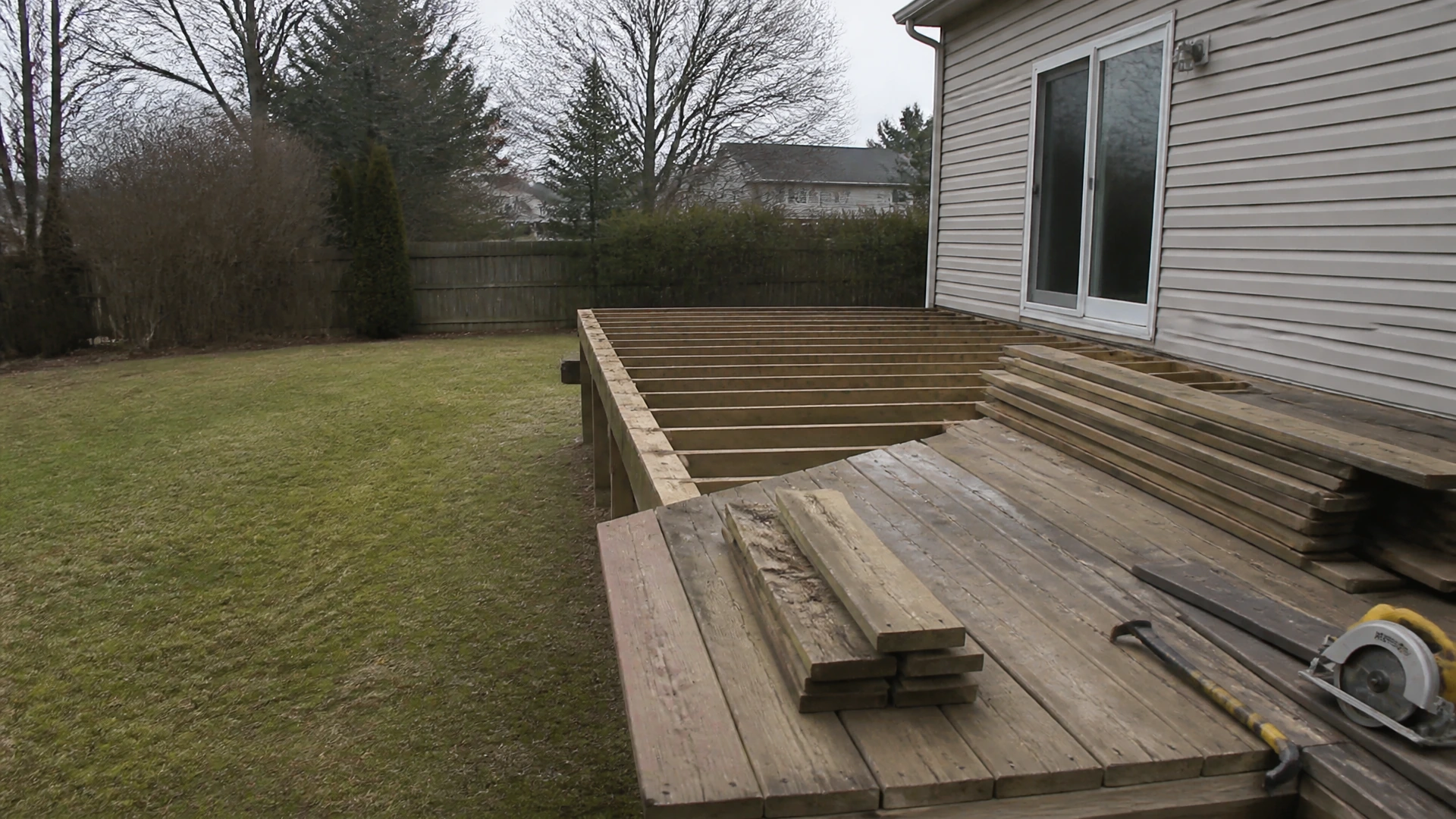
Deck Removal in Akron, Canton and Northeast Ohio
Deck removal usually starts with one board that gave a little too much under somebody's foot. Then you look closer and see the railing wobbles, the stairs are soft, and the posts are black where they go into the ground. At that point you're not sure if the deck needs fixing or needs to go, and you're not sure who to even call about tearing one out.
- Owner-operated
- Owner on site for the work
- Free site visit and free written estimate
- Fully insured, $2 million general liability and workers comp
My name's Vental Waggoner. Zenith Excavating is my company, it's based in Akron, and it's two of us, with me on site for every job. We take out decks in seven counties, Summit, Stark, Portage, Wayne, Tuscarawas, Mahoning and Columbiana, and that includes the backyards of Stow, Green and North Canton. The price covers hauling it all away, backfilling and finish grading, so when we leave, you've got a clean yard, not a pile of rotten lumber and a row of holes.
Tear it out or fix it?
Not every bad deck has to come out, and I'll tell you if yours doesn't. A deck that's been kept up can last a long time. Wood decks commonly run 15 to 30 years, and composite about 25 to 30. Freeze and thaw is hard on wood, and Ohio gives a deck plenty of both.
Here's what tells you a deck is failing. Boards that are split, warped, soft or rotten. Rusty nails and hardware, especially where the deck meets the house. Joists, which are the framing boards underneath that hold the deck up, that have cracked or soaked up water. Posts rotting where they sit in wet ground. Railings that move when you lean on them. Any one of those is a reason to stop using the deck until somebody looks at it.
Whether it's a repair or a tear-out comes down to the frame. If the framing underneath is solid and the board bolted to the house is sound, new decking on top might be all you need. That's a carpenter's job. If the framing is rotten, the lumber is undersized for the span, or the joists are spaced too far apart, putting new boards on it just hides the problem. Then it comes out. People also tear out a perfectly good deck because they want a different size or shape, or a patio instead, and that's a fine reason too.
What deck removal costs
We looked for a published market price for deck removal that names where its numbers come from and when, and couldn't find one. So I'm not going to put somebody's guess on this page. Here's what moves the price.
The price is built per job, and with us it covers the labor, the tear-out, the haul-off, the dump fees, and the backfill and finish grading. What moves it is mostly size and height. A low deck sitting a foot off the ground is a different job from a second-story deck with long stairs, because everything up high has to come down safely. Multi-level decks take longer. The material matters too, since hardwood and composite cost more to get rid of than plain treated pine. Footings, which are the concrete pads or piers under each post, are work of their own. And access matters, meaning whether a machine and a truck can get to the backyard or everything gets carried out.
Shrubs, flower beds and pavers built in around the deck add work.
The free site visit and written estimate
I'll come look at the deck in person and write you up an estimate, and neither the visit nor the estimate costs anything. You'll know the price before any work starts, and it's on paper.
Permits and safety checks
Taking a deck down usually doesn't need the same permit that building one does, but it depends on where you live and whether the deck is attached to the house. This varies from one building department to the next, so check with your city or township's building or zoning office before the job. If you're putting up a new deck afterward, that almost always needs a permit, so ask about both at once.
Before anything comes apart, I walk the deck for hazards. Outlets, lights and wiring run along a lot of decks. Broken boards have nails sticking out of them. And bees and wasps love the space under a deck. If there's a hot tub on it or wired to it, that circuit has to be dead before we touch anything, and the tub is its own job, covered on our hot tub removal page.
How the tear-out goes
A deck comes apart in roughly the reverse of how it went up. The railings and any lattice skirting come off first. Then the deck boards. Then the joists and beams, then the board against the house. The stairs usually come out last, since they're the way down. On a lot of decks it's faster to cut the decking into sections between the joists than to pry up every board one at a time.
It's the two of us, and I'm on site running the job the whole time. How long it takes depends on size and height. A small deck sitting on the ground can go in part of a day, and a big raised deck can take a day or two.
Backyard decks are where access gets tricky. A fence with a narrow gate, a steep slope, or a pool right next to the deck can mean more hand work and some planning about where everything gets stacked.
The ledger board and the house wall
This section is the one I want people to read. The ledger is the board bolted flat against your house that the whole deck hangs on. When it comes off, it's held on with big lag bolts, and it has to come off slowly, because what's behind it is the wall of your house. On older decks, water has often been getting in behind the ledger for years. Once it's off, the sheathing and the rim board behind it can be soft. Sometimes the flashing that was supposed to keep water out was never there.
We're a demolition company, not carpenters. If your wall has a problem, you want to know about it before the siding goes back on, not after.
Then there's the back door. Once the deck is gone, a door that used to open onto the deck opens onto a drop, sometimes a long one. That's a real fall hazard, especially with kids in the house. Until it's handled, keep that door locked.
Footings and the ground underneath
Most decks sit on concrete footings at each post. Good ones last for decades, and if you're building a new deck the same size in the same spot, a builder may want to keep them. If you're not, they're lumps of concrete in your yard that will catch a mower blade for years. When they come out, the holes get backfilled and the area finish graded, because that's included.
The space under a deck is its own little world. Bare mud, old junk somebody stashed under there twenty years ago, and sometimes a groundhog or a skunk that moved in. I'll tell you what, I'd rather know about the skunk before we start pulling boards.
Where the old deck goes
Everything goes with us when we leave. Debris haul-off is included. What happens to it after that depends on what it's made of. Untreated wood can be chipped. Metal hardware and railings can go for scrap. Composite boards can go to a plastics recycler where one takes them. Some people want to keep good boards to reuse for raised beds or a fence, and that's fine if you tell me before we start.
Pressure-treated lumber is different. It's full of chemicals, so we never burn it, and you shouldn't either. Rules on where treated lumber can go vary, so if you're getting rid of some yourself, check with the county.
After the deck is gone
Once the deck is out, the ground under it is finish graded to match the yard, so you're starting from level ground. What comes next is up to you. A new deck, a patio, or just grass. We don't build decks or pour patios. We get the spot ready and hand it off.
People ask how soon they can seed or pour where the deck stood. Ground that sat under a deck for twenty years is usually bare and packed down, and anywhere footings came out is fresh fill that will settle some.
Doing it yourself vs hiring
A small deck sitting on the ground is a reasonable weekend job for somebody with a pry bar, a saw and a truck, and I'll tell you that if it's what you've got. It saves you money. Raised decks are where people get hurt. Beams are heavy, you're working off ladders, and the ledger is right against your house wall. Then there's the hauling. A deck makes a lot more debris than people expect.
Who does the work
When you hire anybody for this, ask for proof of insurance and get the scope in writing, including what happens to the footings and the debris. Here's what you get with us. Zenith Excavating was founded in 2022. I'm on site for every job. Our coverage is $2 million in general liability, with workers compensation on top, and I'll show you the certificate. It's two of us, which means the guy who gave you the estimate is the guy doing the work.
Questions People Ask
Will the truck tear up my lawn getting to a backyard deck?
Anything heavy crossing a yard leaves some sign it was there, and soft ground makes it worse. Point out your sprinkler heads and any soft spots at the site visit.
Can I stay home and use the house while you tear the deck out?
Plan on not using the door that opens onto the deck that day.
Can you take a deck out in the winter?
Wind, heat and cold all make a tear-out harder, and snow on the boards makes it slippery.
Can I keep some of the boards?
Tell me at the site visit which ones you want, and we'll plan to set them aside instead of loading them. Keep in mind that boards from a rotting deck are usually rotting too.
There's a hot tub on my deck. Can you do both?
The hot tub has to come off before the deck does, with the power shut off first. It's a separate job, and I explain it on our hot tub removal page.
Request a Free Estimate. Fill in roughly how big the deck is, how high it sits off the ground and the address, then press Send My Request. If you'd rather talk it over, the number is (330) 690-6842, Monday through Friday from 7 in the morning to 5.