
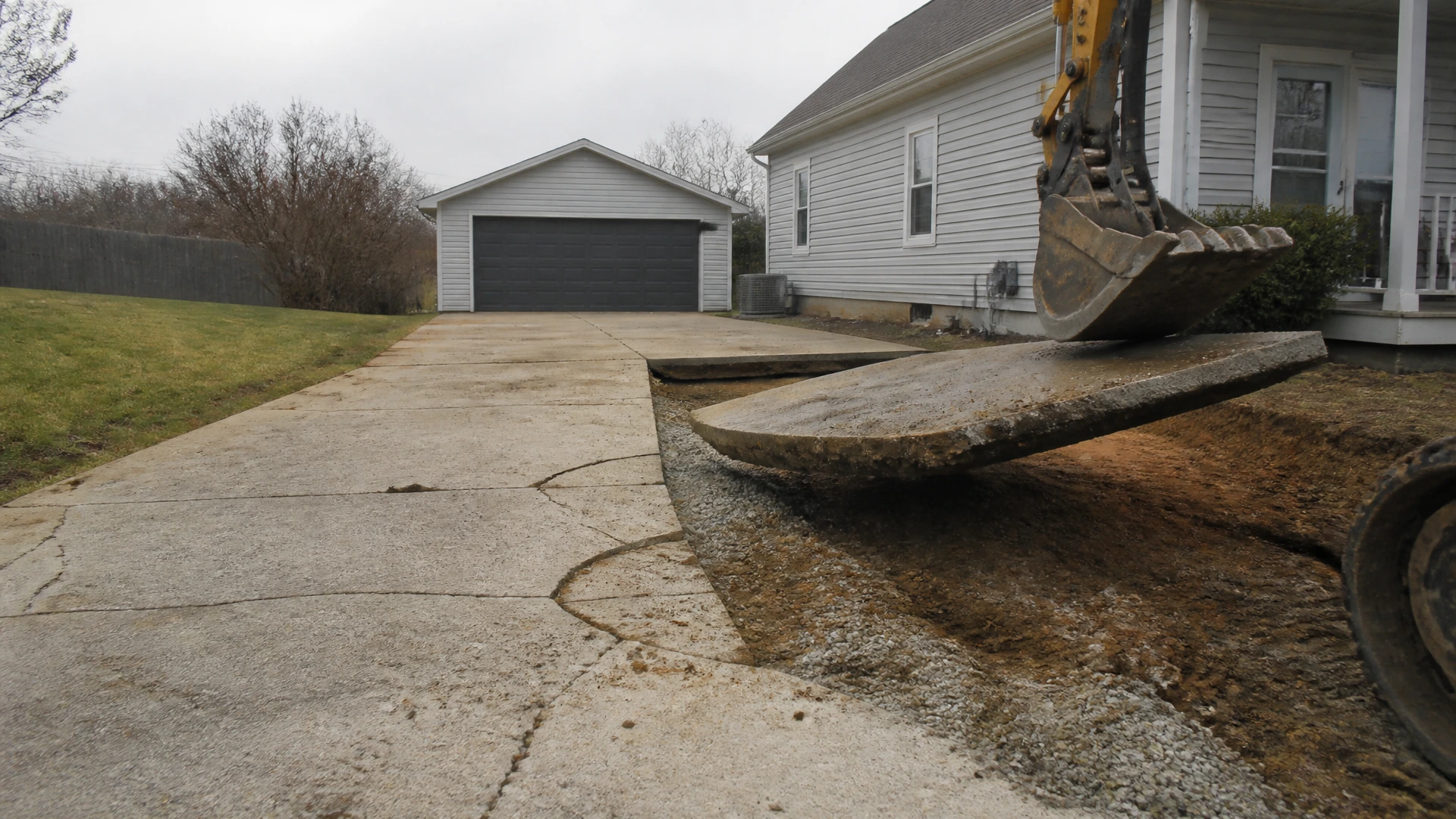
Concrete Removal in Akron, Canton and Northeast Ohio
If you're looking up concrete removal, you've probably got a slab that's done. The driveway heaved and split after a few Ohio winters, the patio out back sank toward the house, or the front steps pulled away from the porch and somebody is going to catch a toe on them. I'm Vental Waggoner, I own Zenith Excavating, and when we take out concrete it's me on the machine and one other guy on the ground. That's the whole outfit, and I like it that way.
- Owner-operated
- Owner on site for the work
- Free site visit and free written estimate
- Fully insured, $2 million general liability and workers comp
Here's the part most people don't think to ask about. Breaking concrete is the easy half. The other half is where it all goes and what the ground looks like when the truck pulls away. With us, haul-off, backfill and finish grading are part of the price, so you're not left looking at a pit full of gravel and loose dirt. The shop address is 3397 E Waterloo Rd in Akron, and the seven counties we take concrete out of are Summit, Stark, Portage, Wayne, Tuscarawas, Mahoning and Columbiana. So a sunken walk in Barberton, a split drive in Cuyahoga Falls or a tipped patio in Massillon is all in range.
Patios, sidewalks and steps
Most of the concrete people want gone is the small stuff around the house. A back patio that tipped toward the foundation. A walkway with one slab sticking up two inches. A set of front steps that cracked off the porch. These jobs look small, but they sit right next to things you want to keep, like the house, the siding, the downspouts and the lawn, so the machine work has to be careful.
A patio that's really a pool deck is its own animal. There can be footings hiding under the decking, and the more decking and landscaping there is around it, the longer the breaking takes. If the pool is coming out too, that's a pool job first, and I'd send you to our pool removal page. If your patio sits under or beside an old wood deck, the deck usually comes out first, and our deck removal page walks through that side of it.
Driveways
A driveway is the job people worry about most, mostly because it's how they get in and out of the house. The questions I hear are simple. Do I have to be home? Can I still park? How long is the garage stuck?
My advice either way is to pull the cars out to the street the night before and plan on the garage door being useless until the new drive is in, because once the old one is gone there's nothing to drive on but fill.
If your driveway runs down to the street, the last few feet, called the apron, often sits in the city's strip of land. That piece can come with its own rules, and I cover it in the permits section below.
Asphalt, brick and mixed rubble
Not every old drive is concrete. Some are asphalt. Some walks are brick or stone laid on sand. And plenty of older properties have a patchwork of all of it, where somebody poured concrete over brick or ran asphalt up to a concrete slab. Some outfits haul asphalt, brick, stone and block along with the concrete, and some only want clean concrete.
If you've got a mix, tell me at the site visit and I'll look at it with you.
Retaining walls
A concrete retaining wall is a different job from a flat slab. The wall is holding dirt back, so when it comes out, that dirt either needs a new slope or a new wall, and somebody needs to decide which before we start. If the wall is part of a foundation or a basement, that's house work, and it's covered on our house demolition page.
Parking lots and commercial flatwork
I'll be straight with you. Big lots with traffic control and work phased around a business that stays open are a different kind of job, and there are companies built for highways, streets and warehouse floors. We're two guys. We'll take the commercial work that fits a two-man crew and say so plainly when it doesn't. If you've got a commercial building coming down along with the lot, start with our commercial demolition page.
Remove or repair?
Not every cracked slab needs to come out. If the concrete has a few surface cracks but it's still flat and solid, resurfacing can make sense, and that's a job for a concrete finisher, not me. Where removal earns its keep is when the slab has settled, heaved or broken into pieces that move. That's a trip hazard, and you can't fix it by pouring new concrete right over the top, because the cracks underneath come right back through.
I'd rather tell you to call a finisher than sell you a tear-out you didn't need.
The free site visit and written estimate
I'll drive out, walk the slab with you, and put a number in writing, and neither one costs you anything. You get one number on paper that covers the breaking, the haul-off, the backfill and the finish grade. Ask me for the insurance paperwork and you'll see $2 million in general liability plus a workers compensation policy.
What moves the number is pretty plain once you're standing on the slab. How big it is. How thick it is. Whether there's steel inside it, meaning rebar (steel rods) or wire mesh. How far the machine and the truck have to go to reach it, and whether there's a gate, a fence or a hill in the way.
Permits and utility locates
Whether you need a permit to take out a driveway, a patio or a curb cut depends on where you live. Each city and township around here sets its own rules on it, so check with yours before the job.
Buried lines are the other thing. Gas, electric, water and cable can run right under a driveway or a walk, and nobody should break concrete without knowing where they are. Ohio uses the 811 call system to get buried lines marked.
The city sidewalk and the driveway apron are a special case. Those pieces usually sit in the right of way, which is the strip of land along the street that belongs to the city, even though you mow it. Work there can take its own permit. Check with your city or township on this one, because the answer is different from town to town.
How the job goes
It starts with the free site visit and the written estimate. Then the locate. Then on the day of the job, we protect what's staying, break the slab, load it, haul it, and fill and grade the spot. Here's how that plays out.
Protecting your yard comes first. A loaded truck and a machine crossing grass will leave marks if nobody plans for it.
Then we break it. I run the machine, and the concrete comes apart in pieces small enough to load. If there's rebar or mesh in it, the steel gets pulled out of the chunks as we go, so it can be scrapped and the concrete can be hauled clean. Where we're breaking right up against something that stays, like a garage floor or the neighbor's drive, a straight saw cut along the edge keeps the break from running where it shouldn't.
Under most slabs there's a layer of gravel. Some people want it left because a new pour is going right back on it, and some want it gone so they can plant grass.
How long all this takes depends on the size, the thickness and how much steel is in it. A plain walkway and a thick reinforced drive don't take the same amount of time.
Buried tanks, asbestos and other surprises
Every so often there's something under the slab that nobody knew about. An old oil tank. A cistern. A second, older slab poured years before the one on top. A septic lid. Tank cleanup and anything that needs testing goes to people licensed for it. That's not us.
Concrete on its own is not hazardous. What can change things is what's stuck to it. Old floor tile glue, called mastic, on a basement or garage slab can contain asbestos, and old paint on concrete can contain lead. If that's on your slab, a licensed abatement contractor handles it before we break anything. Zenith coordinates with that contractor. Zenith does not do the abatement itself. Whether a survey or a notice to the state is needed depends on the job, so check with the abatement contractor and the Ohio EPA before work starts.
After the concrete is gone: backfill and grading
This part matters as much as the breaking, and it's the part I'm proudest of. When we pull out a slab, the hole gets backfilled and the spot gets finish graded to match the yard around it. That's in the price. The spot is left level, and from there it can take a new pour, a flower bed or grass seed, your call.
People ask how soon they can pour new concrete, lay sod or plant on the spot. The honest answer is that fill settles, and how long to wait depends on how deep the hole was and what went back in it.
If the patio you're removing sat right against the house, pay attention to the grade. Water runs downhill, and if the new ground slopes toward the foundation, you'll find out in the basement.
Doing it yourself vs hiring
To be truthfully honest, some concrete jobs are fine to do yourself. A few stepping stones or a small pad behind the shed doesn't need a machine. Breaking a real slab by hand is a different story. It's slow, it's hard on your back, the jackhammer and saw rentals charge by the day, and every load you haul costs you a trip and a tipping fee at the other end.
If yours is smaller than that, I'll tell you, and I'll tell you how I'd go about it.
Questions People Ask
Where does the broken concrete go?
It goes one of two places. Clean concrete can go to a recycler that crushes it into gravel for new jobs, which is often cheaper than a landfill. Concrete with heavy steel in it, or mixed with other junk, goes to a landfill that's allowed to take construction debris. If you're searching for a place to dump concrete yourself, call ahead, because not every site takes every load, and check with the county on which sites are licensed to take it.
Can I just bury the broken concrete in my yard?
Maybe, but don't guess. There are conditions on burying clean broken concrete as fill, and wetlands and flood areas are a different matter. Check with your county health department before you do it. Dumping it somewhere it isn't allowed can get you in real trouble.
Can you take out concrete in the winter or right after it rains?
The concrete doesn't care about the weather. The yard does. A loaded truck on soft, wet ground leaves ruts that take a season to go away.
How loud is it, and will it shake my house or the neighbor's?
Breaking concrete is loud while it's happening, there's no getting around it. Our hours are Monday to Friday, 7 to 5, and Saturday by appointment.
Is steel inside the slab a problem?
Not a problem, just more work. Rebar and wire mesh hold the slab together, so it breaks slower, and the steel has to be separated before the concrete can be recycled. It's one of the reasons two slabs the same size can price differently.
How much does concrete removal cost?
It depends on size, thickness, steel and access. You'll get our number in writing after the free site visit.
Request a Free Estimate. Describe the slab you want gone, give me the address, and hit Send My Request, and I'll be in touch about walking it. Phone works too: (330) 690-6842, weekdays between 7 and 5.