
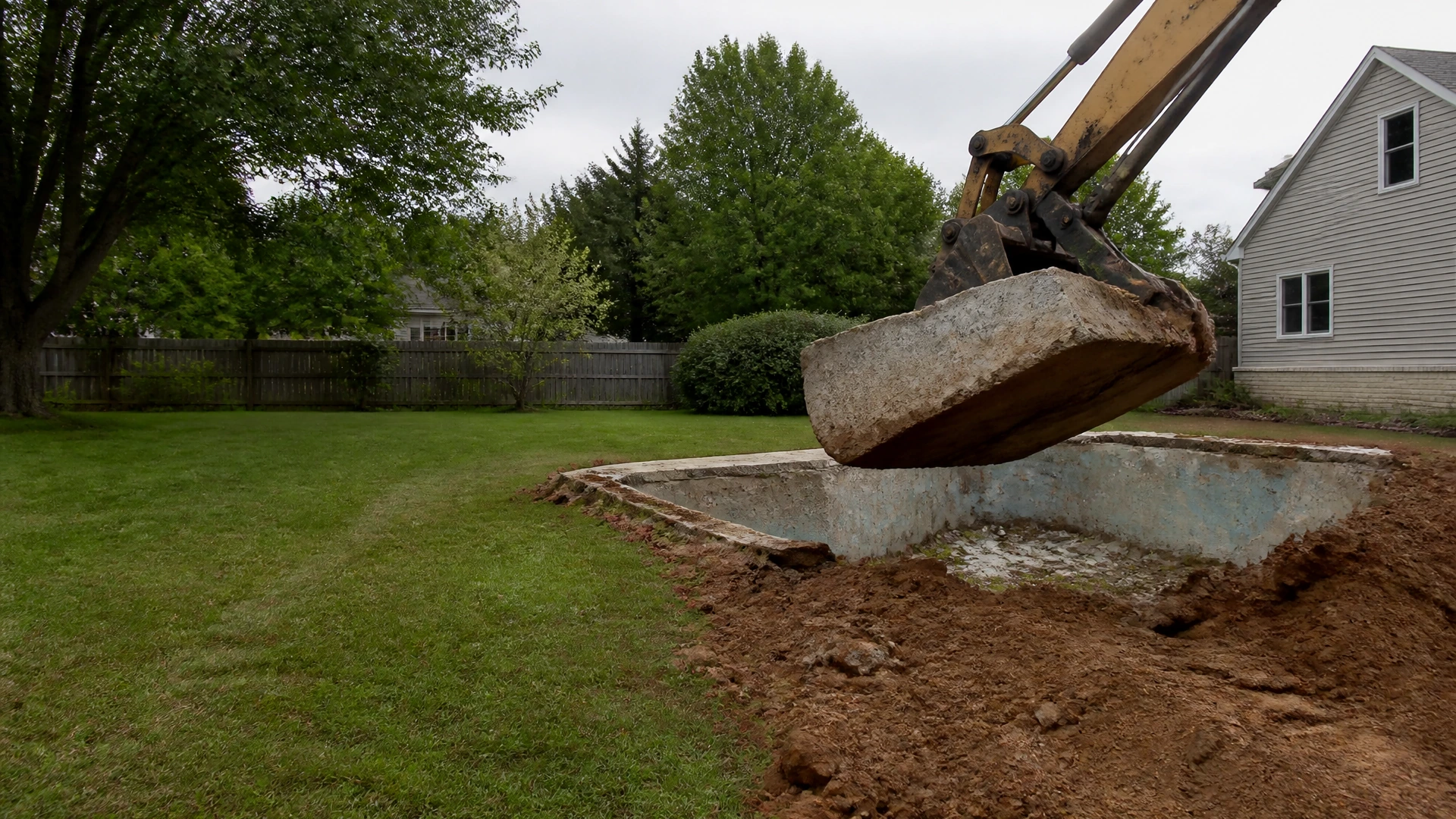
Pool Removal in Akron, Canton and Northeast Ohio
If you're looking into pool removal, the pool has probably stopped earning its keep a while ago. The cover hasn't come off in a couple of summers, the liner or the plaster is going, and you're still paying to open it, close it and keep it insured, so pool removal starts to look like the cheaper road.
- Owner-operated
- Owner on site for the work
- Free site visit and free written estimate
- Fully insured, $2 million general liability and workers comp
My name's Vental Waggoner. There are two of us at Zenith Excavating in Akron, and I'm the one on the machine, so the guy who walks your yard for the estimate is the same guy who breaks the pool out and grades the spot when we're done. Hauling the debris off, backfilling the hole and finish grading are part of the price. They don't show up later as extras.
Here's what you should know before you call anybody, me included.
Why people take a pool out
The reasons are pretty consistent. A pool that leaks, a liner that's failing, plaster that's rough and cracked, and a repair quote that's more than the pool is worth to you anymore. Then there's the money that goes out every year on chemicals, power and water for a pool that mostly sits there. Some people want the yard back for a garden or a lawn the kids can actually use. Some want to cut the liability and what the pool adds to their insurance. And a lot of people are getting a house ready to sell and don't want a tired pool to be the thing a buyer fixates on.
None of those reasons is wrong. The point is to know which one is yours, because it decides the next question.
Partial or full removal: which one fits
There are two ways to take an inground pool out, and they're not the same job.
A partial removal, sometimes called a fill-in, leaves most of the shell in the ground. The top of the wall gets broken off, usually somewhere between 18 inches and 3 feet down. Holes get punched through the floor so water can drain out the bottom instead of sitting in a buried bowl. Then the broken concrete gets dropped into the shell and the whole thing is filled and packed down.
A full removal takes everything. The walls, the floor, the rebar, the plumbing and the equipment pad all come out and get hauled off. What's left is a clean hole that gets filled with clean material and packed in layers, so there's nothing buried under your yard later.
So which one? Full removal costs more up front because there's a lot more concrete to haul. Partial costs less, but it leaves a shell in the ground, and that has two side effects. In a lot of places you can't put a garage, an addition or even a shed on top of a partial fill without an engineer signing off on the soil. And when you sell, a buried pool can be something you have to tell the buyer about, where a full removal usually leaves nothing to disclose. Some buyers see a pool as a deal-breaker and some see a filled pool the same way, so it cuts both ways. If a sale is coming, ask your real estate agent or attorney how the Ohio disclosure form treats a filled-in pool before you pick.
I'll tell you plainly which one I think fits your yard and your plans. If a partial removal does the job, I'm not going to talk you into the bigger one.
Above-ground pools
An above-ground pool is a different animal. There's no concrete shell to break. The water comes out, the liner gets cut and folded, the top rails and uprights get unbolted, and the steel wall gets rolled up. If there's a wood deck built around it, that comes apart next, and then the metal gets sorted for scrap and the ground gets graded and seeded. Steel, resin and aluminum pools all come apart about the same way. The ones that get messy are the pools that were partly sunk into the ground or have been sitting so long the yard has grown up around them.
Plenty of people take a small above-ground pool down themselves over a weekend, and if you've got the time and somewhere to take the scrap, that's a reasonable call. A big one with a deck attached is more work than it looks. If the deck is the bigger part of the job, our deck removal page covers that side of it.
How a pool comes out, step by step
Draining it. The water comes out first. Pool water is chlorinated, so it gets dechlorinated before it goes anywhere, and where it's allowed to go is set locally. Some areas don't want chlorinated water in the storm system at all and point you to the sanitary sewer clean-out or to letting the lawn soak it up slowly. Check with your city or your sewer district before anyone pulls the plug.
Breaking the shell. A concrete pool gets broken up with a hydraulic breaker on the machine, which is basically a giant jackhammer on the end of the arm, and a hand jackhammer for the tight spots. A fiberglass pool can sometimes be cut and lifted out in big sections instead. Either way, the machine has to get from the street to the pool, so the route through your yard matters as much as the pool does.
I run the machine myself on every job. That's not a slogan. There are two of us, and that's how it works.
Permits and utility shut-offs
Most places want a permit before a pool comes out, and some ask for engineered plans or a soil report on top of it. Many also want an inspection before demolition, to see that the power, gas and water are disconnected, and another after the hole is backfilled to check how it was packed and how it drains. Those inspections can add weeks to the calendar. The rules aren't the same from one city or township to the next in Summit, Stark and Portage counties, so check with your city or township before you plan around a date.
The pool's equipment has to be shut off and taken out before any concrete gets broken. That means the gas off at the heater, the breakers off and the wiring pulled, and the supply and return lines capped or removed at the pad. The pump, filter and heater come out with it.
Then there's what you can't see. Gas, electric and water lines often run near or right through the pool area, and so can a septic tank, a drain field or a sewer line. Those get marked through the 811 call-before-you-dig system before the machine digs anything.
Backfill, compaction and final grade
This is the part that decides whether you've got a nice flat yard in two years or a dip where the deep end used to be.
The fill depends on the job. A partial removal usually gets broken concrete at the bottom, then gravel and soil. A full removal on ground you might build on gets engineered fill, which is just fill material picked and packed to a spec so it won't settle. A full removal can take 60 to 90 cubic yards of material, which is a lot of truckloads. On top of that goes a cap of topsoil, often 8 to 10 inches, so grass will actually grow.
Packing it down, or compaction, happens in layers. Contractors call the layers lifts, and the usual practice is to keep each one to about 12 inches and pack every layer before the next one goes in. You can't rush this part.
The last step is the grade, which means shaping the ground so water runs away from your house instead of toward the basement. Backfill and finish grading are included in our price.
Will the ground sink, and can you build there later
It depends on how the pool came out and how the fill went in.
After a partial removal, most places won't let you build on the spot without a soil engineer signing off, and some won't allow a shed or a small addition at all. A full removal with engineered fill gives you the most room to build later, and in some places that can mean a garage or a small guest house. Some jurisdictions want a compaction test before they'll sign off on a building there, which is a separate step done by a testing firm. Whether your town requires one is a question for your city or township.
If you're not building, the options are wide open. Garden beds, a patio, a play lawn or a rain garden all work. A lot of people wait a season for the soil to settle before they put in anything big.
Where the debris goes
A typical inground pool turns into 15 to 30 cubic yards of broken concrete and debris, and on a full removal that's a big part of why the bill is higher. Somebody has to load it, truck it and pay to dump it. Concrete can often be sorted out and recycled instead of going to a landfill.
Debris haul-off is included in our price, so it isn't a separate line you have to chase down. Debris should go to a licensed disposal or recycling site, and dust gets kept down while the concrete is being broken. If you want to know what's allowed for disposal where you live, check with the county.
If the machine hits a buried tank or old fill
Older yards hide things. An old heating oil tank. A septic tank nobody mapped. A pocket of buried trash a previous owner filled a low spot with. Nobody covers this, and it's one of the first things I'd want to know if it were my yard.
If we hit something like that, the work on that spot stops. Who has to be notified depends on what it is, especially if it's a fuel tank, so check with your city or township and the county before anything else gets dug around it.
Living at home during the job
Most people stay home while a pool comes out, and that's fine. We work Monday through Friday, 7 to 5, so you'll know when the machine is running and when it's quiet. The questions people actually have are about the driveway and the back door: can you still get the car out, and can the kids still get in and out of the house. That gets worked out at the site visit, before any work starts.
The other question is the hole itself. Between when the shell is broken and when the fill is packed, there's an open pit in your yard overnight, maybe for a few nights. If it rains in the middle of the job, that pit takes water. Keep kids and pets away from it until it's filled, and ask how it gets covered when I come out.
Protecting your yard, driveway and trees
A machine and loaded trucks crossing a yard can crack a driveway, snap sprinkler lines and tear up a lawn. Your quote should say in plain words who pays for that if it happens, from anybody you're talking to. For the record, the policy behind our work is $2 million in general liability, with workers compensation on top.
Trees near the pool are their own concern. The roots spread wide, and heavy equipment over the root zone can hurt a tree you want to keep. Some local rules call for fencing or root-zone protection around trees during demolition, so ask your city or township.
How long it takes and which months work
Across the market, an above-ground pool usually comes down in about a day, or half a day with no deck. A partial inground removal is usually a few days on site. A full removal can run up to a week, and the whole job from first visit to grass can stretch to a couple of weeks once permits, rain and a tight yard get involved.
Then there's the Northeast Ohio question. Can a pool come out in the winter, on frozen ground? It depends on the ground, the access and the fill, and it's worth talking through at the free site visit.
What your written estimate spells out
Whoever you hire, the estimate should say in writing whether it's a partial or a full removal and how deep the walls get cut. It should say who gets the permit, what fill goes in and how it gets packed, how the machine gets into the yard, who fixes any damage on the way in, where the debris goes and whether grading is part of it. If any of that is missing, ask before you sign.
Our written estimate is free, and so is the site visit that comes before it.
Who does the work
Two people, that's the whole company. I opened Zenith in 2022, and when a pool comes out of your yard, I'm the one breaking it. Our shop is at 3397 E Waterloo Rd in Akron.
We'll take a pool out anywhere in Summit, Stark, Portage, Wayne, Tuscarawas, Mahoning and Columbiana counties, whether the yard is in Green, North Canton, Stow or Cuyahoga Falls. To be truthfully honest, most of the big demo companies around here are set up for general contractors, not for somebody with a pool in the back yard. That's the work I want. The rest of what we tear down is on the Zenith Excavating home page.
Questions People Ask
Can I take my own pool out?
Some of it, sure. Draining the pool or pulling down a fence yourself can save some money, and plenty of people handle that part. Breaking up a concrete shell, hauling it and packing the fill in layers is a different story, and you still need the same permits as a contractor would.
Is there something cheaper than taking it out?
Sometimes. If the shell is sound and the problem is a worn surface, resurfacing it might get you more years. Some people turn the pool into a deck instead of removing it. If your pool really just needs a repair, I'm going to tell you that, because that's a pool company's job, not mine.
Can I keep or sell the pump, heater, ladder or safety cover first?
It's your equipment, so bring it up at the free site visit. Anything you want to keep or sell has to be out of the way before demo day.
Does the price include the fill dirt and grading?
Yes. Backfill, finish grading and hauling the debris off are all part of our price. A lot of quotes you'll see split those out, so compare them line by line.
Do you charge to come look at it?
No. The site visit is free and the written estimate is free. I'd rather walk the yard and see the gate width, the trees and the slope than guess at it over the phone.
Do you work outside Akron?
Yes. We're based in Akron, but a pool in Kent, Massillon or Wooster is just as much in range. The seven counties are listed a little higher on this page.
If you've got a pool you're done with, Request a Free Estimate and I'll come out and walk it with you. The form takes a minute, just hit Send My Request.